The prices of food items included in a household food basket for December were slightly down compared to November 2025 and December 2024.
Although this seems like good news for low-income consumers, the small amounts they saved will probably not help them afford school supplies for the new school year.
The Pietermaritzburg Economic Justice and Dignity Group compiles the household food basket as part of its Household Affordability Index based on a price survey completed by women who live in low-income communities at places where they shop.
It tracks the prices of 44 basic foods from 47 supermarkets and 32 butcheries in Johannesburg, Durban, Cape Town, Mtubatuba in Northern KwaZulu-Natal and Springbok in the Northern Cape.
Household food basket for December little less expensive
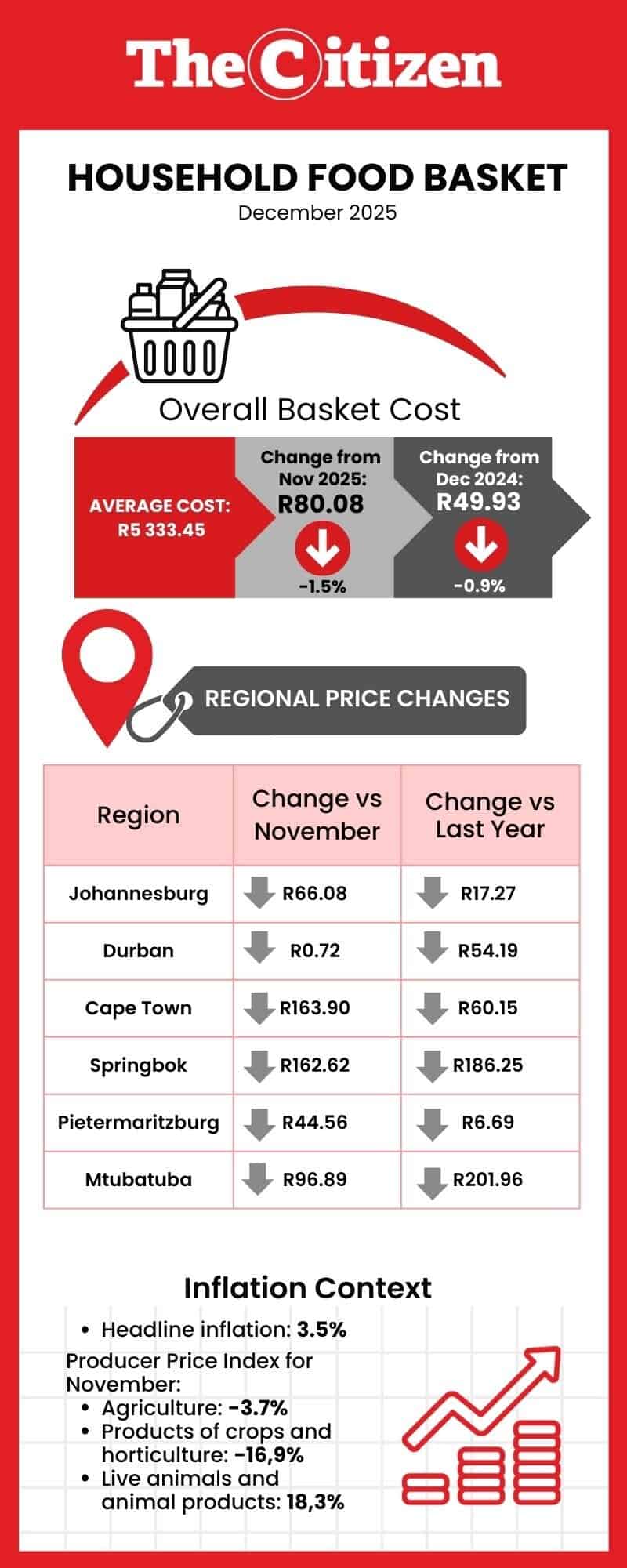
The latest survey shows that the average cost of the household food basket was R5 333.45 in December, R80.08 (-1.5%) less than in November and R49.93 (-0.9%) less than in December 2024, rising to R5 333.45 in December 2025.
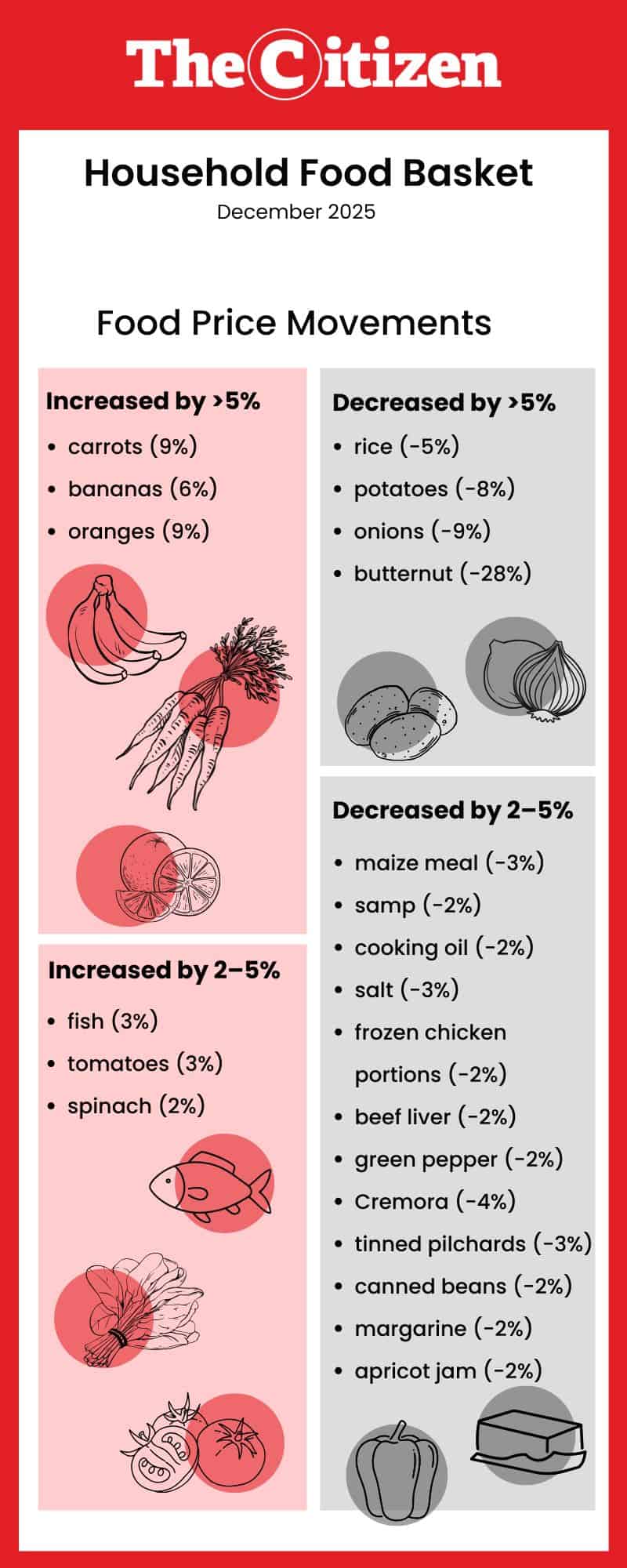
The food pricing trends in December 2025 show that 18 of the food items in the household food basket cost more, while 26 items cost less than in November, as this chart illustrates:
Food items in the household food basket that cost more than 5% more in December compared to November, include carrots (9%), bananas (6%) and oranges (9%).
Food items in the household food basket that cost more in December than in November by between 2% and 5% include fish (3%), tomatoes (3%) and spinach (2%).
On the other hand, food items in the basket which decreased in price in December 2025 by 5% or more include rice (-5%), potatoes (-8%), onions (-9%) and butternut (-28%). Food items in the basket which decreased in price in December 2025 by between 2% and 5% include maize meal (-3%), samp (-2%), cooking oil (-2%), salt (-3%), frozen chicken portions (-2%), beef liver (-2%), green pepper (-2%), Cremora (-4%), tinned pilchards (-3%), canned beans (-2%), margarine (-2%) and apricot jam (-2%).
Different household food basket prices in different areas
Prices of food items in the household food basket also differed from area to area, as this chart shows:
In December 2025, the household food baskets in Johannesburg, Cape Town, Springbok, Pietermaritzburg, Mtubatuba and Mthatha cost less than in November, while the average Durban food basket remained largely unchanged, with a marginal price increase.
The Johannesburg household food basket cost R66.08 (-1.2%) less than in November and also decreased by R17.27 (-0.3%) compared to a year ago.
The Durban household food basket cost R0.72 (0.0%) less than in November and R54.19 (-1.0%) less compared to a year ago.
The Cape Town basket cost R163.90 (-3.1%) less than in November and decreased by R60.15 (-1.1%) compared to a year ago.
The Springbok basket cost R162.62 (-2.8%) less compared to November and decreased by R186.25 (-3.2%) compared to a year ago.
The Pietermaritzburg basket cost R44.56 (-0.9%) less than in November and decreased by R6.69 (-0.1%) compared to a year ago.
The Mtubatuba basket cost R96.89 (-1.8%) less than in November and decreased by R201.96 (-3.7%) compared to a year ago. Statistics South Africa’s Consumer Price Index and Producer Price Index.
In addition, Statistics SA’s Producer Price Index for November shows that agriculture was -3.7%, with products of crops and horticulture at -16.9% and live animals and animal products at 18.3%.
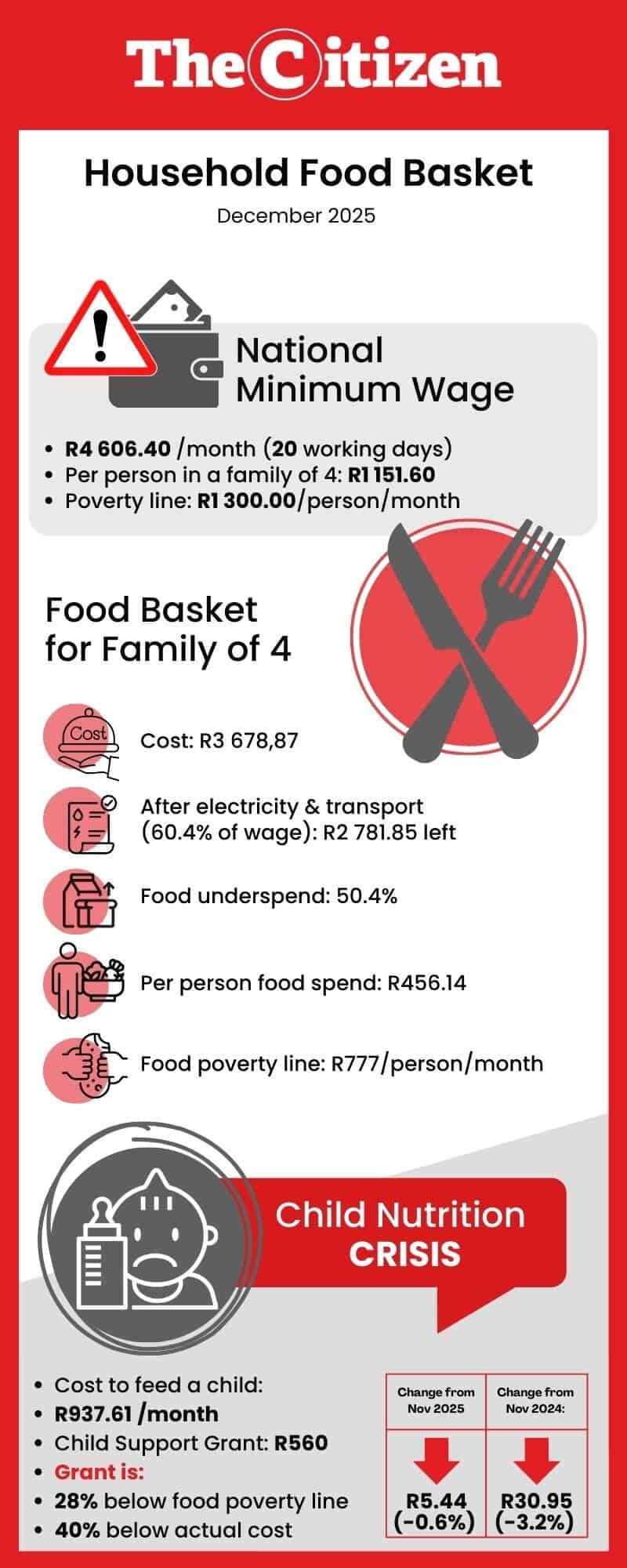
How does all this affect low-income consumers and workers who earn the national minimum wage of R28.79 per hour, R230.32 for an 8-hour day and R4 836.72 for an average 21-day working month? This chart shows how difficult it is to feed a family of four on this little income:
Minimum wage not enough for family of four’s household food basket
Mervyn Abrahams, programme coordinator at the group, says in December, with 20 working days, the maximum national minimum wage for a general worker was R4 606.40. However, he points out, workers work to support their families and not only themselves.
“The wage workers earn is not just to sustain themselves but to support the entire family. For black South African workers, one wage must typically support 3.9 people. Dispersed in a worker’s family of four, the national minimum wage is R1 151.60 per person, far below the 2023 rebased lower-bound poverty line of R1 300 per person per month as well as the upper-bound poverty line of R2 635 per person per month.”
The average cost of a basic nutritional food basket for a family of four was R3 678,87 in December. Abrahams says the group calculates, using Pietermaritzburg-based figures for electricity and transport and the average figure for a minimum nutritional basket of food for a family of four, that electricity and transport take up 60.4% of a worker’s wage (R2 781.85 of R4 606.40).
Low-income consumers first pay for electricity and transport before buying household food basket
He points out that low-income consumers only buy food after paying for transport and electricity, leaving R1 824.55 for food and everything else. “Therefore, we calculate that in December workers’ families may have underspent on food by a minimum of 50.4%, leaving R1 824.55 over after transport and electricity are paid and with food for the month costing R3 678.87.
“In this scenario there is no possibility of a worker being able to afford enough nutritious food for her family. If the entire R1 824.55 all went to buy food for a family of four, it would provide R456.14 per person per month, far below the 2023 rebased Food Poverty Line of R777 per person per month.
“The Food Poverty Line is a monetary-based threshold, and people who have less than R777 for food cannot afford to eat enough food to meet the minimum daily energy requirements.
For women with children the picture is even worse. In December, the average monthly cost to feed a child a basic nutritious diet was R937.61 after a decrease of R5.44 (-0.6%) compared to November and a decrease of R30.95 (-3.2%) compared to a year ago.
Compare this with the Child Support Grant of R560 per month, which is 28% below the 2023 rebased Food Poverty Line of R777 per month and 40% below the average monthly cost to feed a child a basic nutritious diet (R937.61), to see how women on low incomes must battle to feed their children.
LoanCenter.co.za is a prominent online platform in South Africa that specializes in connecting users with a variety of loan options through its referral service. Unlike traditional lenders, LoanCenter.co.za does not directly provide loans; instead, it serves as an intermediary, facilitating access to reputable financial institutions and lenders. By leveraging an extensive network of partners, the website offers users a streamlined process to find loans tailored to their specific needs, including personal loans, payday loans, and business financing. This service simplifies the borrowing process, ensuring that individuals and businesses can efficiently navigate their financial requirements with confidence.